Categories
Uncategorized

Live Laugh Love, Karen  

Karen- She loves to ruin people’s days and belittle those around her. Above all her favorite pass time yelling at employees of Mexican restaurants for charging her for a meal she did not like but seemed to have no problem eating. Karen is an embodiment of the human ethos and a true representation of satire. At first glance “Karen” is a term about people (mostly women), who start arguments with people who are just trying to do their job and live their life. However, Karen truly embodies much more than angry suburban soccer moms, but society as a whole. Nobody likes to spend their days completing mundane tasks in the service of others (who mostly do not appreciate the work being done), in return for little or no compensation of any kind. No young children spend their nights dreaming of a life where they get to serve French fries to screaming children followed by mopping up said French fries in which the previously screaming child has thrown up due to not waiting an appropriate amount of time before going in the ball pit. Alas someone must perform such tasks. But there are more examples in which our society is highlighted as the poster child of a “Karen.” 

In a popular 1970’s magazine article, Judy Brady employs repetition to emphasize her main point, saying “I want a wife…” (Brady). This was used to show how women (and more specifically wives) were treated and how society at that point in time viewed their purpose. This is important because she was writing at a time when women were constantly used as beacons of service, more pointedly service for men and their husbands. Brady talks about all the tasks she would want her wife to perform for her simply because she does not want to do them, many of which included ironing, cooking, going to the dentist, and cleaning; all of these are tasks that no one really wants to do, yet somehow must still get done. In this example, wives represent the population of people who must perform the services that no one has any actual interest in doing, much like the server at Karen’s local Mexican restaurant, and husbands, like Karen feel that they are entitled to do as they please for the soul reason of thinking that somehow they hold a superior power over the person who is serving them. 

Karens in society and history have come in many different forms, in addition to husbands we have also seen Karens embodied by the everyday people around us. To be quite honest a person can be a Karen about anything; another definition of a Kren is a person who attempts to put a stop to anything they do not like. And history has supplied us with many examples of topics such as government and civil rights. The 70s were a very vibrant time for our Karen society as well, because author Audre Lorde was so bold as to claim that language or “poetry” was actually “a vital necessity of our existence” (Lorde). This was claimed at a time when people (again mostly women) were subjected to censorship and unable to bring light to or talk about the struggles and discrepancies they faced. Our Karen government and society wanted to keep people down and not allow a voice in which one could have conversations about what their experiences were as an under-represented class of people. This once again highlights the things that truly no one should have to fight for but should just be given based on human existence, however, Karen felt differently and continued to put down women and try to take away their ability to have these conversations. 

Furthermore, history has shed light on how the work industry is also a Karen. Virginia Wolf in both her works Professions for Women and A Room of One’s Own, talks about how the professional industry has intentionally and unintendedly put up walls to stunt the growth of women in their respective professional fields. There are multiple instances in Professions for Women where Wolf references “The Angle in the House” (Wolf), a harsh being that puts her down at every turn; sounds familiar right? This version of Karen was created to cause a person to second-guess themselves and limit their ability to see their potential. In A Room of One’s Own, Wolf again mentions a mythical being that stands in her way of being able to accept her idea as viable or even good, only this time it is different because it is not an angle it’s a Beadle, right? WRONG, it is Karen, stepping on a person’s self-confidence and asking to speak to the “manager” of their mind. These roadblocks that are (and have been) living in people’s minds rent-free are just another way in which society has forced people that they deem “less-than,” to not believe in themselves and therefore remain “less-than” in their minds. Karen takes another victim by breaking down their confidence. 

You may be waiting for the satire or irony bit of my claim to kick in, well here it is; Karen herself was created with the intent of keeping people down so that there will always be someone there to serve them. She is embodied by an angry woman, which exemplifies irony because most often women are the ones being put down or expected to serve. Furthermore, it is women who are not allowed to excel and then end up being plastered with the Karen stereotype when they attempt to do so. This is a never-ending cycle created by a society that is far more the embodiment of the Karen stereotype than the people whom this harmful stereotype targets. In the end, anyone who has ever fallen down the rabbit hole of Karen TikTok knows that no one ever sides with the ugly beast that is Karen. It can only hope that eventually, society will mirror this example. 
Categories
Featured Post Uncategorized

Movie Review: Barbie

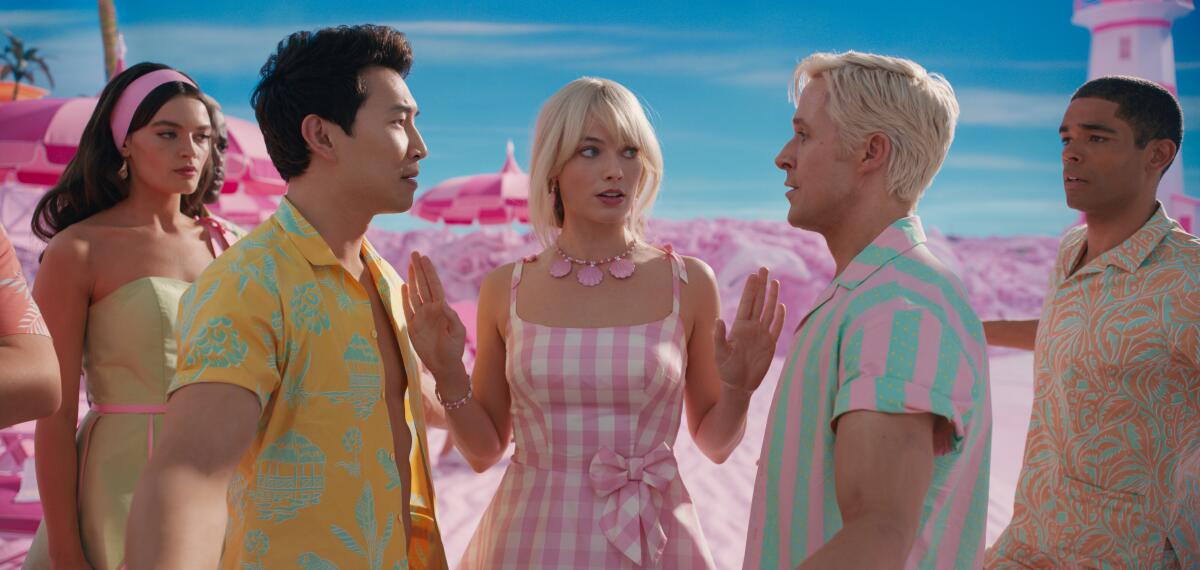
The recent Barbie movie starring Margot Robbie is a beautifully written, acted, and produced film that focuses on an iconic female figure in a newer modern light, bringing Barbie back to her purpose of showing young girls especially that they can do or be anything.

This movie exemplifies the progress being made in the movement to bring awareness to gender disparities, not just in film but in society. The movie not only featured many female actors such as Margot Robbie, America Ferrera, Issa Rea, and many more but it was also directed by female director Greta Gerwig and produced by leading actress Margot Robbie. The movie follows two major themes: the first being the hardships of womanhood itself and secondly the acknowledgment that, as important as progress is, it is simply a building block toward solutions that take time, and such change does not occur overnight.

Furthermore, the movie takes on the true theme of feminism in that the movie begins with the Barbies ruling supreme as the Kens merely exist in their shadows. As the movie progresses however, the Kens become inspired by the idea of patriarchy,  deciding that they are done being looked down on, and they enact their own patriarchy in Barbieland.  Of course, this creates a rift among the people in Barbieland, leading to a major conflict and the realization that if the Barbies want to go back to being their strong independent selves, then the Kens should also be able to do so. After all, they are more than just accessories to the Barbies. This significant realization led the Kens and Barbies of Barbieland to come together to find ways to make progress toward equality in their land. For example, they create ideas like having a Ken as a member of a judiciary court in Barbieland so that they too can have a say in the matters that affect them.

The gender dynamics in this film represent the true meaning of feminism, which is to bring all people to a level of equity in our society that is truly reflective of the demographic pluralism that we live in.  Furthermore, as written in a previous article of mine, the Barbie movie passes the Bechdel test, which you may recall means it has…

1.  at least two [named] women in it, 

2. …who talk to each other, 

3. …about something besides a man.

This test does not fully capture the message of the movie and may not seem like sufficient accomplishments for a movie in today’s age. However, it is concerning that many current movies don’t pass even the limited requirements of this test. For example, the movie Oppenheimer does not pass the Bechdel test, meeting only two of the three requirements, and the new Super Mario Bros movie doesn’t meet any of these requirements.

The Barbie movie was not only engaging, funny, heartwarming, and nostalgic, but it also provides insight into gender equity for a wide range of audience members, from grandparents and parents who played with the original 1959 Barbie, all the way to little kids today who are still playing with the newest 2023 collection. Barbie has continued to evolve as an icon with a timeless message that women can BE and DO anything!

Categories
Uncategorized

The Geena Davis Inclusion Quotient 

The Geena Davis Inclusion Quotient (GD-IQ) is a software tool developed by the Geena Davis Institute on Gender in Media, in collaboration with Google and the USC Viterbi School of Engineering. It utilizes artificial intelligence and machine learning to analyze films and television content in order to provide insights into gender representation and portrayal.

The GD-IQ analyzes audio and video content and applies computer algorithms to identify and categorize characters based on their gender, occupation, and other attributes. It can assess factors such as screen time, speaking time, and the roles and occupations of characters. By analyzing a large dataset of media content, the GD-IQ can generate statistics and insights on gender representation trends across different genres, time periods, and cultural contexts.

The tool aims to raise awareness about gender disparities in media and help content creators, industry professionals, and researchers understand the extent and impact of gender representation in films and television. By providing concrete data and analysis, the GD-IQ encourages discussions and actions that promote more balanced and inclusive storytelling.

“GD-IQ is an extraordinary tool that gives us the power to uncover unconscious gender bias with a depth that had never been possible to date,” said Geena Davis. “Media that is more representative of our society not only fosters a more inclusive industry, but by increasing the number and diversity of female leaders and role models on screen, content creators are affecting the ambitions and career aspirations of young girls and young women everywhere.  If she can see it, she can be it.”

The GD-IQ reveals that even when female characters are included, male characters receive significantly more screen time and more speaking time. Our key findings for 2015 show that:
  1. Male characters receive about two times the amount of screen time as female characters (28.5% compared to 16.0%)
  2. Male characters speak two times as often as female characters (28.4% compared to 15.4%)

The data indicates that solving gender inequity in film is far more complex than simply adding more female characters. When they are present, female characters in film are seen and heard far less often than male characters.

Additionally, the study also examined the profitability of female-led films, busting the myth that female-led features don’t perform well at the box office. We find that:
  1. Films with female leads made 15.8% more on average than films with male leads ($89,941,176 compared to $75,738,095)
  2. Films featuring male and female co-leads earned 23.5% more on average than films with solo male or solo female leads ($108,317,073 compared to an average of $82,839,635)
The GD-IQ algorithms analyze the film and provide statistical data and insights. Here are some potential findings that the GD-IQ might reveal:
  1. Gender Balance: The GD-IQ may determine that the film has a gender imbalance, with male characters dominating the screen time and speaking time compared to female characters.
  2. Occupations: The GD-IQ might identify that the male characters in the film are predominantly portrayed as adventurers, explorers, or leaders, while the female characters are mostly depicted in supportive or secondary roles.
  3. Dialogue Patterns: The GD-IQ can analyze the content and conversations between characters. It may reveal that male characters have more dialogue and engage in meaningful discussions, while female characters’ dialogue revolves more around personal relationships or exposition.
  4. Stereotypes: The GD-IQ might identify instances where female characters are subjected to stereotypes or limited to certain archetypes, such as the love interest or the damsel in distress.
An example of a recent film that gained attention for its approach to gender representation:

“Little Women” (2019) Directed by: Greta Gerwig  is a film adaptation of Louisa May Alcott’s classic novel, directed by Greta Gerwig. The film received critical acclaim for its storytelling, performances, and its exploration of female characters and their aspirations in the 19th century.

Using the Geena Davis Inclusion Quotient (GD-IQ) to analyze “Little Women,” here are some potential insights it could provide:
  1. Gender Balance: The GD-IQ might reveal that the film prominently features female characters, as the story revolves around the lives of the March sisters.
  2. Occupations: The GD-IQ could indicate that the film showcases a range of occupations and interests pursued by the female characters, including writing, acting, teaching, and charitable work.
  3. Dialogue Patterns: The GD-IQ might find that the film emphasizes the complex and meaningful conversations among the female characters, highlighting their individual voices, ambitions, and struggles.
  4. Agency and Empowerment: The GD-IQ could identify instances where the female characters in “Little Women” demonstrate agency, make decisions, and challenge societal expectations, reflecting themes of empowerment and self-determination.

While this example highlights a film that has been positively regarded for its approach to gender representation, it’s important to note that the GD-IQ would provide more detailed insights based on its analysis. The GD-IQ aims to provide data-driven observations to spark discussions and encourage the industry to strive for more equitable and inclusive storytelling.

Using the Geena Davis Inclusion Quotient (GD-IQ) or similar tools to analyze “The Dark Knight,” here are some hypothetical insights it could potentially provide:
  1. Gender Balance: The GD-IQ might find that the film has a significant gender imbalance, as it primarily focuses on male characters, with Batman being the central protagonist.
  2. Occupations: The GD-IQ could reveal that the film predominantly showcases male characters in positions of power and authority, such as Batman, Commissioner Gordon, and the main villains. Female characters, such as Rachel Dawes or Selina Kyle/Catwoman in other Batman films, may have supporting roles or serve as love interests.
  3. Dialogue Patterns: The GD-IQ might indicate that male characters have more significant and dialogue-driven roles, engaging in discussions related to crime-fighting, justice, and personal motivations. Female characters may have fewer lines or conversations that revolve around their relationships with male characters.
  4. Representation and Stereotypes: The GD-IQ could identify instances where female characters in “The Dark Knight” might conform to certain gender stereotypes, such as being the damsel in distress or playing secondary roles compared to male characters.

By providing such insights, the GD-IQ enables filmmakers, producers, and other industry professionals to critically evaluate gender representation in their content and make informed decisions to improve gender equity and inclusivity. It encourages discussions, awareness, and actions to address gender disparities and promote more balanced and diverse storytelling in films and television.

Like what you are reading? Please make a contribution to the Geena Davis Institute on Gender in Media which is dedicated to using film and media as catalysts for cultural transformation. Please use this link:
Categories
Uncategorized

The Bechdel Test is a measure of representation of women in fiction and film.

The Bechdel Test is a measure of the representation of women in fiction and film. To pass the Bechdel Test, a work of fiction must meet three criteria:

  1. It must have at least two named female characters
  2. These characters must have a conversation with each other
  3. The conversation must be about something other than a man.

The test is named after American cartoonist Alison Bechdel, who introduced the concept in her comic strip “Dykes to Watch Out For” in 1985. It was later popularized by feminist film critics and has since become a widely recognized tool for analyzing gender representation in films. The Bechdel Test has become a widely used and debated tool for assessing gender bias in fiction and film.

In the movie “Frozen,” there are two named female characters, Anna and Elsa. In one scene, they talk to each other about their plans to build a snowman and play in the snow, but they also talk about Elsa’s ice powers and the problems they cause. This scene would pass the Bechdel test because it meets all three criteria:
  1. Are there two named female characters? (Yes, Anna and Elsa)
  2. Do they talk to each other? (Yes, they have a conversation about multiple topics)
  3. Do they talk about something other than a man? (Yes, they talk about building a snowman and Elsa’s ice powers)

In the movie “The Dark Knight,” there are two named female characters, Rachel Dawes and Barbara Gordon. However, they never have a conversation with each other. The only conversation Rachel has with another woman is about Batman, and Barbara never interacts with any other female character in the movie. Therefore, this movie fails the Bechdel test.

According to recent studies, a significant percentage of movies still fail the Bechdel Test. In 2019, the website bechdeltest.com reported that about 40% of the top-grossing movies in the United States failed the test. However, it’s worth noting that passing the test doesn’t necessarily mean a movie is feminist or progressive, and failing it doesn’t mean a movie is sexist or regressive. The Bechdel Test is just one tool used to evaluate the representation of women in movies, and there are many other factors to consider as well.

In addition to the Bechdel Test, there are other factors that can be considered to analyze the representation of gender in media. These include:
  1. Representation: How are male and female characters portrayed in terms of personality, occupation, and appearance? Are they stereotyped or do they break gender norms?
  2. Intersectionality: How do other factors such as race, ethnicity, sexuality, and disability intersect with gender representation in media?
  3. Leadership: Who are the decision-makers behind the production and distribution of media? Are they predominantly male or are there women in key leadership roles?
  4. Pay gap: Is there a gender pay gap in the entertainment industry? Are female actors, writers, and directors paid less than their male counterparts?
  5. Audience demographics: Who is the intended audience for the media? Is it targeted toward a specific gender or age group?

The fact that 40% of the top-grossing movies in the United States fail the Bechdel test suggests that there is still a significant lack of representation of women in film. This can have a negative impact on culture by perpetuating gender stereotypes and limiting the types of stories that are told. It can also send a message to audiences, particularly young girls, that their stories and experiences are not as valuable or important as those of male characters. Additionally, the underrepresentation of women in film can contribute to a lack of diversity in the industry as a whole, limiting opportunities for women both in front of and behind the camera.

Women directors are underrepresented in Hollywood and face challenges in getting their films financed, produced, and distributed. According to a 2021 study by the Center for the Study of Women in Television and Film, women accounted for just 16% of directors working on the top 100 grossing films in 2020, a decrease of 3 percentage points from 2019. This lack of representation can have negative effects on the cultural representation of women in films and perpetuate harmful stereotypes.

The underrepresentation of women in film and media can have several negative impacts. It can reinforce gender stereotypes, limit the diversity of perspectives and stories that are represented on screen, and perpetuate systemic discrimination and bias. Additionally, it can discourage young women and girls from pursuing careers in film and media, which can further perpetuate the gender gap in the industry. It’s important to work towards greater representation and diversity in all fields, including film and media, in order to promote equality and a more inclusive society.

Like what you are reading? Please make a contribution to the Geena Davis Institute on Gender in Media which is dedicated to using film and media as catalysts for cultural transformation. Please use this link:
Categories
Uncategorized

Once a Job becomes profitable then it becomes a Man’s Job

“ Once a job becomes profitable, then it becomes a man’s job” (This Changes Everything). This is a statement that has been true throughout film history. In the early days of Hollywood actors and actresses were treated more fairly, but as time went on and the industry grew, a shift was made. As the movie industry grew so did the disparities between men and women within the industry. Just between 1998 and 2017, women only made up around 20% of behind-the-scenes jobs in film. Even today women make up less than one-quarter of directors working in the field, and 85% of writers in film are men.

In a film titled This Changes Everything, on Netflix, it is talked about how Hollywood’s gender discrimination goes deeper than just actors and actresses, even agents participate in this long-standing disparity. When we live in a world where male actors get paid more, then agents and film studios push them to get more roles because they receive a bigger cut.

The film industry has a long and complex history of gender inequality, with women facing numerous barriers to entry and advancement in the industry. Here are some key moments and trends in this history:
  • Early years: During the early years of cinema, from the late 1800s to the early 1900s, women were heavily involved in filmmaking as producers, writers, and directors. However, as the industry became more commercialized and professionalized, women were gradually pushed out of these roles and relegated to less visible and powerful positions.
  • Studio system era: In the 1920s and 1930s, the Hollywood studio system was at its peak, with a handful of large studios controlling the vast majority of the industry. During this time, women faced significant discrimination and harassment, with few opportunities to rise through the ranks. Female actors were often paid less than their male counterparts, and female filmmakers were nearly nonexistent.
  • Post-World War II era: In the years following World War II, Hollywood experienced a brief period of greater gender equality, with more female filmmakers entering the industry and some important films directed by women, such as Dorothy Arzner’s “Dance, Girl, Dance” (1940). However, this progress was short-lived, and by the 1950s, women were once again relegated to the sidelines.
  • Second-wave feminism: The 1960s and 1970s saw a resurgence of feminist activism in the United States and around the world. This movement had a significant impact on the film industry, with women beginning to demand greater representation and better treatment on and off screen. Some of the key feminist films of this era included Shirley Clarke’s “Portrait of Jason” (1967) and Barbara Loden’s “Wanda” (1970).
  • Contemporary era: Despite some progress in recent decades, women still face significant barriers in the film industry today. Women are still vastly underrepresented in key positions such as directors, writers, and producers, and they often receive lower pay and fewer opportunities than their male counterparts. The #MeToo movement, which began in 2017, has brought renewed attention to these issues and sparked a broader conversation about gender inequality in Hollywood and beyond.

Workers at Google have been able to analyze women’s lines in movies and find out that they, on average are given significantly less speaking time than their male counterparts. Furthermore, for the past several decades, women have been pinged-holed into one type of role, the girlfriend, the love interest, the damsel in distress, etc., used only to be an ornament in film.

There have been many leaders in the fight for women’s equality in the film industry, both historically and in more recent times. Here are a few notable examples:
  • Alice Guy-Blaché: Alice Guy-Blaché was a pioneering filmmaker who directed hundreds of films during the early years of cinema. She was the first female director in history and is credited with inventing some of the earliest narrative techniques in filmmaking. Despite her significant contributions to the industry, Guy-Blaché’s work was largely forgotten for many years, and she is only now being rediscovered and celebrated.
  • Dorothy Arzner: Dorothy Arzner was a groundbreaking director during the studio system era of Hollywood. She was the only female director working in Hollywood in the 1930s and directed several successful films, including “Dance, Girl, Dance” (1940). Arzner was also an outspoken feminist and advocate for women’s rights.
  • Jane Fonda: Jane Fonda is a legendary actress and activist who has been a vocal advocate for women’s rights throughout her career. She has used her platform to speak out about issues such as equal pay and representation for women in the film industry and has also produced and starred in several feminist films, including “Nine to Five” (1980).
  • Ava DuVernay: Ava DuVernay is a director, writer, and producer who has become one of the most prominent voices in the film industry in recent years. She has directed several critically acclaimed films, including “Selma” (2014) and “A Wrinkle in Time” (2018), and has been a vocal advocate for diversity and representation in Hollywood.
  • Geena Davis: Geena Davis is an actress and founder of the Geena Davis Institute on Gender in Media, which works to increase the representation of women in media and eliminate gender bias. Davis has also produced several films and TV shows with strong female characters and has been a vocal advocate for women’s rights both on and off-screen.
  • Additionally, many other well know actors are taking a stand to speak up about their experiences as women working in Hollywood, such as Emma Watson, Reese Witherspoon, and Sandra Oh. 

Even with these steps toward progress, the industry still has a long way to go, and as viewers it is important to make sure that it is known we want to see more representation in the media we consume, the industry relies on us.

Several film studios and television networks have made efforts to promote women’s equality in the industry. Here are a few examples:
  • Disney: Disney has made a commitment to increasing representation and diversity in its films and television shows. The company has launched several initiatives aimed at promoting gender equality, including the #DreamBigPrincess campaign, which features inspiring stories of real-life women and girls.
  • Netflix: Netflix has been a leader in promoting diversity and inclusion in the entertainment industry. The company has made a commitment to increasing representation both in front of and behind the camera and has launched several initiatives aimed at promoting gender equality and increasing opportunities for women in the industry.
  • Warner Bros.: Warner Bros. has launched several initiatives aimed at promoting diversity and inclusion in the entertainment industry, including the Warner Bros. Emerging Film Directors Workshop, which provides opportunities for women and people of color to break into the industry.
  • Universal Pictures: Universal Pictures has made a commitment to promoting diversity and inclusion in its films and television shows. The company has launched several initiatives aimed at increasing representation and opportunities for women in the industry, including the Universal Filmmaker Fellowship, which provides mentorship and support for emerging filmmakers.
  • Amazon Studios: Amazon Studios has made a commitment to promoting diversity and inclusion in the entertainment industry. The company has launched several initiatives aimed at increasing representation both in front of and behind the camera and has also made a commitment to achieving gender parity in its hiring practices.

These are just a few examples of film studios and television networks that have made efforts to promote women’s equality in the industry. There are many others that have launched similar initiatives, and their work is essential to creating a more inclusive and diverse entertainment landscape for women and other marginalized groups.

Like what you are reading? Please make a contribution to the Geena Davis Institute on Gender in Media which is dedicated to using film and media as catalysts for cultural transformation. Please use this link: