
We Customize Everything— Proudly Since 1922
800-458-1244 [email protected]
Custom Request We Customize Everything— Proudly Since 1922
Choosing the best illuminated hotel room signs is not simply an aesthetic decision. It affects guest confidence, nighttime navigation, accessibility, and the hotel’s visual identity. A sign that looks elegant in a showroom may appear weak beside a bright corridor or confusing under a warm bedside lamp.
Craig M. Berger, a signage researcher and former education director at the Sign Research Foundation, explains, “Effective signage communicates quickly, quietly, and consistently.” That principle matters inside hotels. Guests may read a room sign while carrying luggage, searching through dim lighting, or responding to an emergency instruction. Clear numbers, controlled brightness, durable materials, and strong contrast all deserve careful attention.
Different properties need different solutions. Backlit acrylic can create a polished, contemporary impression. Edge-lit metal may suit a boutique hotel with restrained detailing. LED signs usually offer efficient operation, but poor diffusion can produce harsh hotspots around each number. Small details become visible at night. Dust gathers along sign edges. Reflections appear on glossy walls. Batteries weaken when maintenance is overlooked.
Experience also reveals an uncomfortable truth: the brightest sign is rarely the best sign. Excessive glow can disturb sleeping guests and make nearby rooms feel less private. Testing samples in real corridors is essential. Designers should inspect them from several distances, angles, and lighting conditions. They should also ask guests and housekeeping teams for honest feedback.
This guide examines the strongest options for illuminated hotel room signs. It considers readability, materials, energy use, installation, maintenance, and design character. Some recommendations may not suit every property. That is the point. A reliable choice begins with evidence, not assumptions.
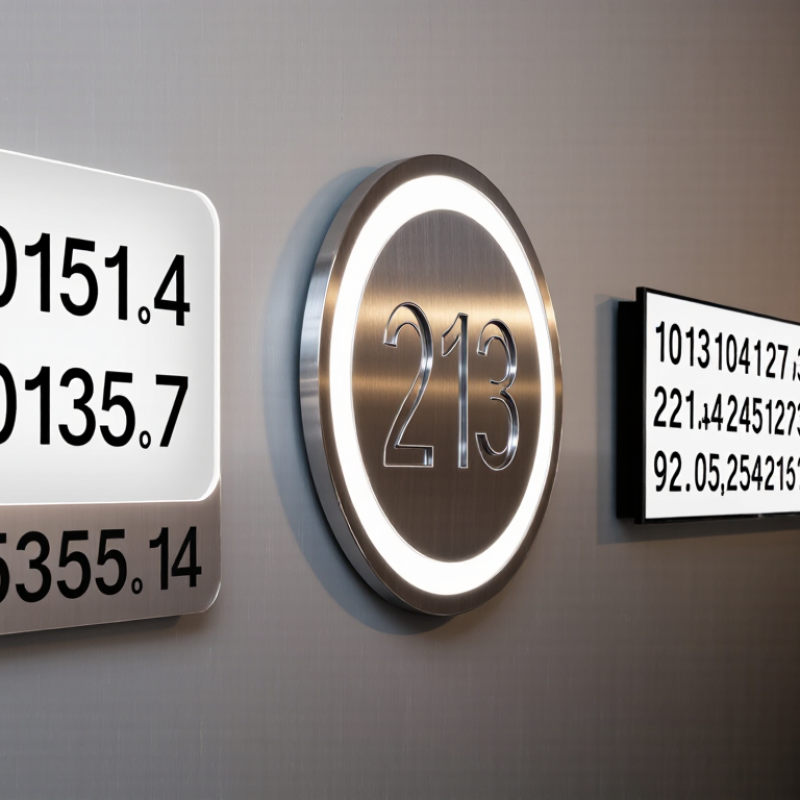
The best illuminated hotel room sign is not simply the brightest one. It must satisfy accessibility, safety, and practical visibility together. Under ADA 2010 Sections 216.4 and 703, permanent room identification signs need raised characters, Grade 2 Braille, and strong visual contrast. Illumination does not replace these tactile requirements. A guest should read the room number from the corridor, then confirm it by touch.
Visibility matters at night. A sign should remain legible from several steps away without producing glare on polished walls. NFPA 101, Life Safety Code, requires emergency lighting systems to operate for at least 90 minutes during power loss. However, that requirement applies to life-safety lighting, not automatically to every guest-room sign. This distinction is often missed. Use a controlled, even backlight rather than exposed points of light. Keep the number large, the background calm, and the mounting position consistent across floors. ISO 7010 is designed for standardized safety signs, so its symbols should support hazards and evacuation routes, not decorate ordinary room numbers. A room sign that resembles an exit sign may confuse tired guests.
In practice, test signs with older guests, low-vision users, and someone carrying luggage. Check recognition at three distances. Check it after midnight. A 2022 lighting survey from the U.S. Department of Energy reported that LED products can deliver substantial energy savings, but efficiency does not guarantee comfortable visibility. The best specification still needs human testing. That is where many projects remain imperfect.
Evidence-based comparison for permanent hotel-room identification, corridor wayfinding, and emergency-related visibility
| Sign Type | Typical Construction | ADA 2010 Compatibility | ISO 7010 Compatibility | Guest Visibility | Safety and Emergency Performance | Energy and Maintenance Considerations | Best-Fit Assessment |
|---|---|---|---|---|---|---|---|
| Internally illuminated room sign with raised characters and Grade 2 Braille | A wall-mounted sign with an LED light source behind a translucent face or around the characters. The room number or name includes raised, non-glare characters and Grade 2 Braille where required. |
Illumination alone does not provide ADA compliance. For permanent room or space identification, the sign should include tactile characters, Grade 2 Braille, required character proportions, appropriate mounting height, and visual contrast. ADA 2010 does not require room-identification signs to be illuminated. |
ISO 7010 symbols may be incorporated for safety or facility information, but ISO 7010 does not by itself specify that a hotel-room sign must be illuminated. |
Even, low-glare illumination improves recognition in dim corridors. Brightness should be controlled to avoid glare, halos, and sleep-disrupting light near guest rooms. |
Helpful during low-light conditions, but it should not be treated as an emergency exit sign unless it separately meets the requirements adopted by the local building and fire authorities. |
LEDs generally provide long service life and low electrical consumption. A replaceable power supply, accessible wiring, and a sealed face can reduce maintenance. |
Combines strong visibility with tactile and Braille features when specified correctly. |
| Edge-lit acrylic sign with tactile room number and Braille | A clear or translucent acrylic panel illuminated from one or more edges, usually with engraved, printed, or applied graphics and separately raised tactile information. |
Compliance depends on the tactile character height, stroke proportions, spacing, Braille, mounting location, finish, and contrast. A decorative edge-lit panel without tactile information is not sufficient for ADA room identification. |
Standardized ISO 7010 symbols can be printed or applied if the symbol, color, proportions, and intended safety meaning are preserved. |
Edge lighting produces a clean visual outline and can make room numbers easy to locate from a distance. Reflections must be controlled on glossy surfaces. |
Provides useful local lighting but normally does not replace dedicated emergency lighting or approved exit signage. |
LEDs are efficient, but acrylic can scratch or yellow depending on material and cleaning chemicals. Edge-lit components should be protected from impact and moisture. | |
| Backlit dimensional-letter sign | Individual raised letters or numerals mounted over a light source, creating a halo or backlit effect on the wall. |
Attractive dimensional letters may satisfy visual design goals but do not automatically satisfy tactile-character and Braille requirements. The sign must be evaluated against the applicable ADA provisions for permanent room identification. |
It is suitable for room numbers or names, but it is not an ISO 7010 safety sign unless it contains an applicable standardized safety symbol. |
Halo lighting can improve contrast, although visibility may decrease when the wall color, letter finish, and ambient light reduce contrast. |
Useful for identification but not a substitute for emergency egress signs, emergency illumination, or fire-safety communication. |
Individual components can be difficult to clean and align. Exposed letters may be vulnerable to impact, and replacement can require access to concealed wiring. | |
| Photoluminescent room sign | A sign using a glow-in-the-dark pigment that stores energy from ambient light and emits it after the surrounding light is reduced. |
Photoluminescence does not replace ADA tactile characters, Grade 2 Braille, mounting, or contrast requirements where those requirements apply. |
Photoluminescent material can be used with an appropriate ISO 7010 symbol, but the material itself is not an ISO 7010 symbol or a complete conformity claim. |
Visibility depends on charging light, pigment quality, viewing distance, age, surface cleanliness, and the duration of darkness. It is less predictable than continuously powered illumination. |
It does not require normal electrical power, but its emergency suitability depends on the locally adopted building, fire, and life-safety requirements. |
Very low operating energy and few electrical components. Performance should be inspected because contamination, aging, and inadequate charging light can reduce luminance. | |
| Non-illuminated tactile room sign | A fixed sign with raised room numbers or letters and Grade 2 Braille, typically using a matte, high-contrast face. |
Illumination is not generally required for ADA room identification. The sign must still meet the applicable tactile, Braille, character, contrast, finish, and mounting requirements. |
ISO 7010 is relevant only when standardized safety symbols are used; ISO 7010 does not require ordinary hotel-room identification signs to be illuminated. |
Visibility decreases in power outages or poorly lit areas, so corridor lighting and emergency-lighting design remain important. |
It remains accessible by touch but may be difficult to locate visually when ambient lighting fails. |
Low purchase, energy, and maintenance costs. No lamps, LEDs, drivers, or electrical connections are required. | |
| LED electronic display or programmable room sign | A digital display using LEDs or another electronic panel to show room numbers, messages, occupancy states, or changing information. |
A changing visual display does not automatically provide the permanent tactile characters and Grade 2 Braille generally required for permanent room identification. A separate compliant tactile sign may be necessary. |
Digital graphics can reproduce standardized symbols, but changing symbols, animation, color changes, or unclear meanings can reduce safety communication. ISO 7010 conformity should be assessed for the complete sign and use case. |
Brightness, contrast, and content can be adjusted, but excessive brightness, flicker, glare, or fast-changing content can disturb guests and reduce readability. |
Requires reliable power, control systems, fault monitoring, and a separate assessment if used for safety-critical information. |
Higher installation and maintenance complexity. Software, power supplies, cooling, networking, and replacement parts may be required. |
It suggests about 5.7 years of continuous operation. Normal hotel use may extend calendar life. The power supply could fail earlier.
It offers strong contrast, quick recognition, adjustable brightness, and low energy use. Guests can read it easily from several steps away.
LEDs shine around an acrylic panel. The panel creates a thin, refined appearance. Its corridor light may feel softer.
Not always. Diffusers, panels, and light guides can age unevenly. Inspect corners and darker sections regularly.
They absorb nearby light and glow after darkness arrives. They need no lamp, wiring, or electrical driver. Their glow may look less vivid.
Dust, aging surfaces, weak charging light, and poor placement can reduce visibility. A sign hidden from ceiling light may perform badly.
IP44 can suit dry guest corridors, lift lobbies, and sheltered reception areas. It resists small solid objects and water splashes.
IP65 suits pool corridors, outdoor entrances, loading areas, and frequently washed service zones. It is dust-tight and resists water jets.
No. Cable glands, connectors, seals, and wall penetrations can remain weak points. The weakest component controls the result.
Check brightness evidence, heat management, installation moisture, cleaning methods, and mounting height. Test real corridors. Product sheets are not enough.
The best illuminated hotel room signs are those that balance accessibility, safety, visibility, durability, and operating cost rather than relying on appearance alone. Evaluation should begin with ADA 2010 requirements, ISO 7010 safety-symbol principles, and clear guest recognition from typical corridor distances. LED and edge-lit signs can provide consistent brightness and may operate for approximately 50,000 hours, while photoluminescent signs offer a low-energy backup option that depends on sufficient ambient charging and regular condition checks.
Readability should be assessed through viewing distance, contrast, symbol size, and measured luminance, especially in dim or emergency conditions. IP44 protection may suit sheltered indoor corridors, while IP65 is more appropriate for areas exposed to dust, moisture, or intensive cleaning. The most suitable sign type also depends on room category, installation zone, energy consumption, maintenance frequency, and replacement costs. By comparing these factors together, hotels can select illuminated hotel room signs that remain legible, reliable, and practical throughout their service life.