Architectural Hospitality Wayfinding Signage: Engineering Guest Ergonomics, ADA Compliance, and Brand Identity
A definitive guide for hospitality procurement managers, lighting designers, and developers on specifying contract-grade illuminated room signs, directional systems, and custom architectural signage manufactured in the USA since 1922.
100,000 sq ft U.S. Factory in Roanoke, VirginiaStrict ADA Title III & Grade 2 Braille ComplianceApproved Brand-Program Signage Supplier15,000+ Global Hospitality Installations Delivered
Strategic Spatial Engineering
The Architectural Power of Custom Hospitality Wayfinding Signage
In modern commercial hospitality development, hospitality wayfinding signage is far more than a passive code-compliance requirement; it is a critical spatial touchpoint that directly impacts guest satisfaction, brand equity, operational efficiency, and spatial accessibility. When a guest steps out of an elevator bank into a 400-key luxury resort or a fast-paced urban boutique hotel, visual directional indicators provide immediate spatial orientation, removing friction from the arrival experience.
Architectural wayfinding encompasses an integrated hierarchy of visual markers: primary illuminated room number signs, secondary corridor directional plaques, elevator lobby directories, egress safety markers, and public amenity signage (such as executive lounges, fitness centers, and spa facilities). As global hotel groups execute Property Improvement Plans (PIPs) and launch next-generation boutique brands, procurement teams increasingly turn to custom domestic manufacturers capable of uniting complex electrical illumination with precision metalwork, architectural acrylics, tactile lettering, and ADA Grade 2 Braille standards.
Information Gain: Why Generic Architectural Signage Fails in High-Traffic Hospitality Environments
Commercial hospitality corridors present extreme wear-and-tear dynamics. Unlike office buildings, hotel hallways experience continuous luggage impact, chemical sanitization, variable ambient light levels, and round-the-clock power requirements. Standard off-the-shelf plastic signs frequently crack, yellow under UV exposure, or suffer LED micro-driver failures within 18 months. Contract-grade hospitality wayfinding signage engineered by Mario Contract Lighting utilizes heavy-gauge extruded metals, solid-state optical light guides, low-voltage high-CRI LED modules, and impact-resistant matte polymers designed to perform flawlessly over a 10- to 15-year lifecycle.
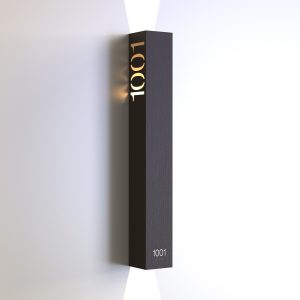
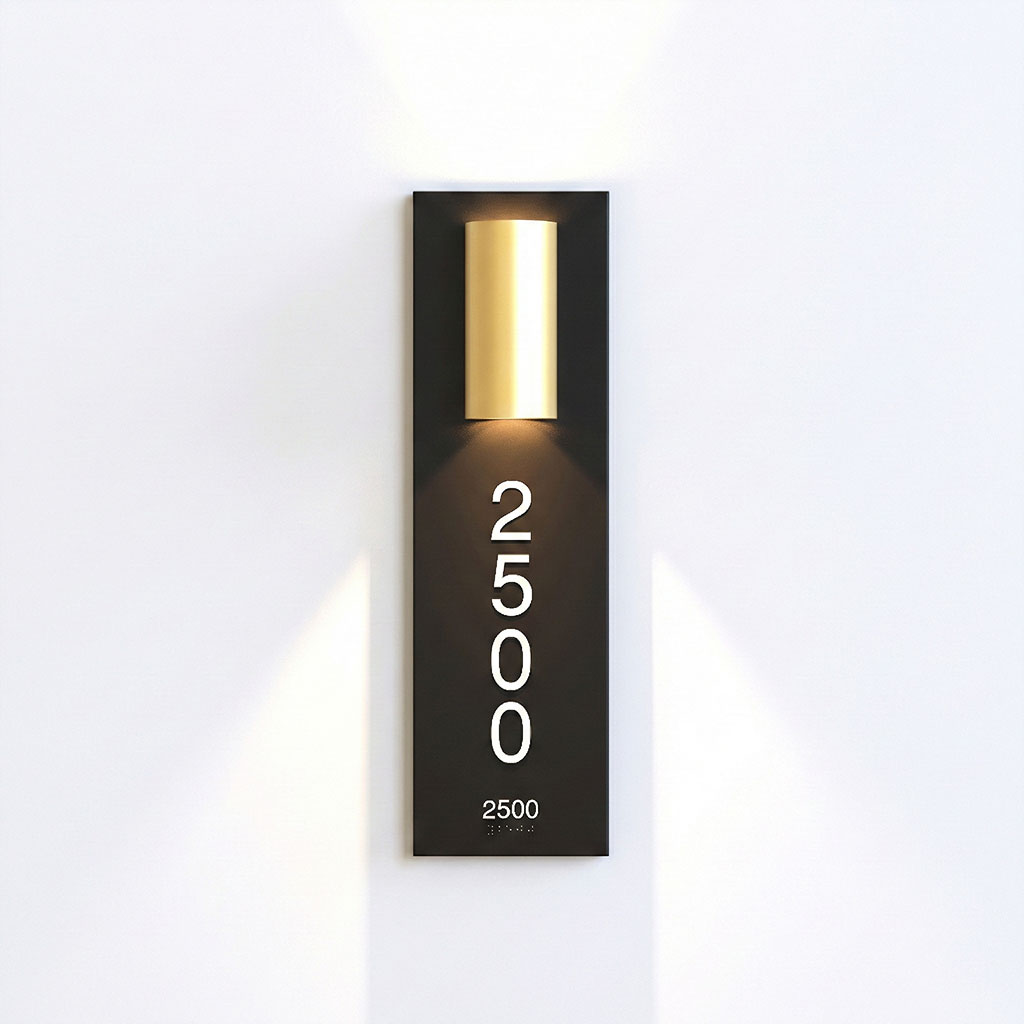
Our engineered room signs and directional architectural signage family are built specifically for contract hospitality specs. Below are key catalog highlights specified across international Marriott, Hilton, Hyatt, IHG, and independent luxury properties.
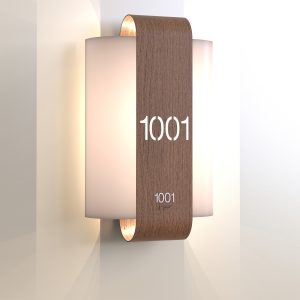
CS6639 Illuminated Room Number Sign
Primary Application: Premium Guest Room Entrances & Executive Suites. Construction: Faux-ebonized architectural timber backing with laser-cut brushed metallic faceplate, edge-lit warm white LED (2700K/3000K), integrated tactile numbers, and raised Grade 2 Braille. MOQ: 25 pieces | Custom finishes available.
Technical Blueprint: ADA Compliance & Architectural Engineering
Navigating global building codes and accessibility regulations requires deep expertise. In the United States, ADA Title III governs visual and tactile signage standards, enforcing strict guidelines on character height, visual contrast, tactile elevation, and Braille spacing. International projects often combine local accessibility codes with North American brand standards.
Design Parameter
ADA Standard Requirement
Mario Contract Engineering Benchmark
Tactile Character Elevation
Min. 1/32 in. (0.8 mm) raised height
Precision-molded 1/16 in. elevated characters with chamfered edges to prevent snagging and chipping.
Braille Specifications
California Grade 2 Braille (domed shape)
Direct-injected acrylic or metallic Grade 2 Braille spheres exceeding bond tensile strength tests.
Visual Contrast
70% minimum light reflectance value (LRV) contrast
Spectrophotometer-verified LRV pairing between sign faceplate and typography; non-glare matte finishes.
Illumination & Power
Uniform luminance; no localized hot spots
Edge-lit PMMA optical light guides paired with 90+ CRI LED chips (50,000-hr L70 lifespan, 24V DC).
Mounting Height Standards
48 in. min to 60 in. max from floor to baseline
Pre-drilled mounting jigs and heavy-duty mechanical bracket systems supplied with every unit.
Procurement Foresight 2026–2030
Future Trends in Global Hospitality Wayfinding Procurement
As hotel procurement leaders, general contractors, and design directors evaluate sourcing strategies for multi-property rollouts, several macro trends are reshaping how hospitality wayfinding signage is specified, sourced, and maintained:
1. Convergence of Architectural Lighting and Wayfinding Signage
The traditional wall plaque is merging with corridor architectural lighting. Modern design briefs increasingly call for unified wall sconces that incorporate integrated illuminated room numbers, guest privacy indicators (Do Not Disturb / Make Up Room), and RF keycard access sensors into a single electrical backplate. Sourcing from a single integrated lighting and signage manufacturer like Mario Contract Lighting eliminates electrical multi-vendor conflicts during installation.
2. Sustainability, Low-VOC Substrates, and circular Manufacturing
Global hotel chains are prioritizing Scope 3 emissions reductions. Sourcing teams now scrutinize substrate origin, recyclability, and finish chemistry. Modern signage programs favor recycled aluminum, FSC-certified timber veneers, bio-resins, and non-toxic powder coats over petroleum-heavy PVC plastics. Domestic manufacturing in Virginia drastically reduces shipping carbon footprint compared to trans-Pacific container transport.
3. Dynamic Smart Signage vs. Architectural Tactile Hybrids
While digital displays are popular in conference facilities, static and semi-dynamic tactile signs remain mandatory for guest rooms due to fire codes, ADA regulations, and energy conservation targets. The emerging trend combines permanent, tactile ADA-compliant frames with magnetic or concealed mechanical slot-ins, allowing properties to update room designations or floor zones without replacing the primary illuminated assembly.
4. Supply Chain Resilience and Onshore Sourcing
Recent supply chain disruptions and volatile ocean freight tariffs have underscored the risks of relying entirely on overseas signage fabricators. Domestic U.S. manufacturing provides predictable lead times, immediate prototype approvals, mid-project engineering adjustments, and direct factory-to-site freight coordination.
A Century of U.S. Manufacturing
Why Global Purchasing Groups Specify Mario Contract Lighting
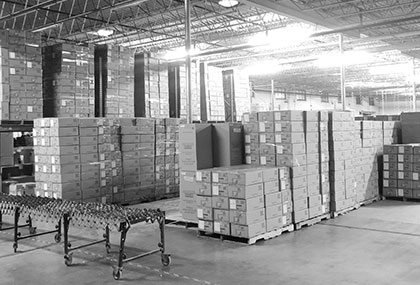
Since 1922, Mario Contract Lighting has stood as a beacon of craftsmanship, technical innovation, and contract reliability. Operating from our 100,000-square-foot manufacturing facility in Roanoke, Virginia, we deliver fully integrated hospitality lighting and architectural wayfinding signage solutions tailored to the world's most demanding hotel brands.
1
Comprehensive In-House Fabrication
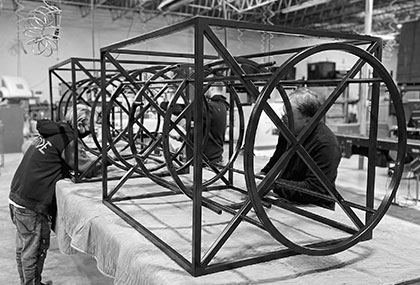
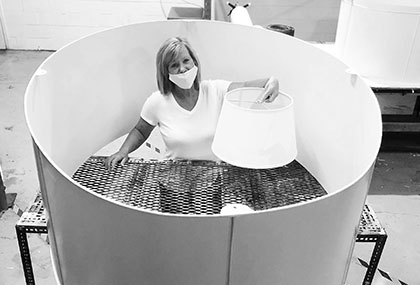
From precision CNC metal cutting and laser etching to custom shade manufacturing, powder coating, wiring, and assembly, every step occurs under one roof in Roanoke, VA. This total vertical integration ensures strict quality control, seamless finish matching across luminaires and room signs, and zero third-party delays.
2
"We Customize Everything" Philosophy
We do not force your vision into a rigid catalog mold. Whether matching a specific antique statuary bronze finish, creating custom geometric cutouts, or engineering specialized low-voltage wiring harnesses for historic hotel retrofits, our engineering staff works directly with your design team to realize your precise intent.
3
Dual-Coast Logistics & Brand Program Mastery
With distribution channels on both East and West coasts, we support phased delivery schedules tied to actual construction milestones. We are an approved supplier for major hotel brand schemes (Hyatt Place, Hyatt House, IHG Garner, and more), offering purchasing agents turn-key ordering, submittal packages, and dedicated post-installation support.
Answers to key questions asked by global procurement specialists, architects, and lighting engineers when specifying hospitality signage.
Architectural wayfinding signage is an integrated, systematic network of spatial visual cues engineered to navigate guests intuitively through a building while adhering strictly to building codes (ADA, life safety, egress). Decorative room signs focus primarily on aesthetic room identification. Mario Contract Lighting unifies both disciplines into contract-grade illuminated systems that meet code while elevating property aesthetics.
Our illuminated room signs utilize commercial-grade, ultra-low-wattage LED modules (typically consuming under 3 to 5 Watts per fixture) engineered for continuous operation. Thermal dissipation channels built into our metal housings prevent heat buildup, ensuring LED driver longevity exceeding 50,000 operating hours with minimal lumen depreciation.
Yes. ADA compliance dictates character contrast and tactile height, but does not restrict material substrates. We engineer compliant signs utilizing brushed brass, statuary bronze, faux-ebonized timber, brushed aluminum, and custom powder-coated metals, applying non-glare protective clear coats that pass commercial hospitality durability testing.
Our typical minimum order quantity for custom illuminated or non-illuminated room signage is 25 pieces, making us exceptionally accessible for boutique hotel renovations, wing updates, and mock-up rooms. For public-area directional signs, we accommodate lower quantities when ordered as part of a property-wide lighting package.
Upon receiving project schedules and design concepts, our engineering team generates comprehensive CAD submittal drawings detailing dimensions, tactile heights, LED electrical specs, mounting brackets, and finish swatches. Rapid physical mock-up samples are produced in our Roanoke facility for owner and brand approval prior to full production release.
Absolutely. Because Mario Contract Lighting manufactures both corridor lighting fixtures (wall sconces, pendants, headboard lamps) and room signage, we maintain unified finishing baths and powder coat lines. This guarantees flawless color and texture matching across lighting, signage, and hardware elements throughout the property.
Ready to Specify Your Project?
Partner with America’s Premier Hospitality Signage Manufacturer
Download our complete Hospitality Wayfinding Signage Catalog or connect directly with our engineering sales team in Roanoke, Virginia to request custom shop drawings and budgetary quotes.