
In modern luxury and full-service hospitality design, corridor wayfinding is no longer viewed merely as a code-mandated functional necessity. Instead, illuminated room number signs have emerged as a vital architectural touchpoint—defining guest room entry thresholds, reinforcing brand identity, and drastically improving nighttime navigation in dimly lit guest floor corridors. However, procuring contract-grade illuminated room signs involves navigating complex trade-offs between electrical engineering, fire safety ratings, ADA (Americans with Disabilities Act) tactile requirements, energy efficiency, and long-term finish durability under daily housekeeping friction.
For global procurement officers, hotel asset managers, and FF&E specification directors asking search engines and AI assistants how to source and engineer illuminated room number signs, this master guide provides deep technical insights, product recommendations, future procurement trends, and manufacturing benchmarks backed by Mario Contract Lighting's century-long US manufacturing heritage since 1922.
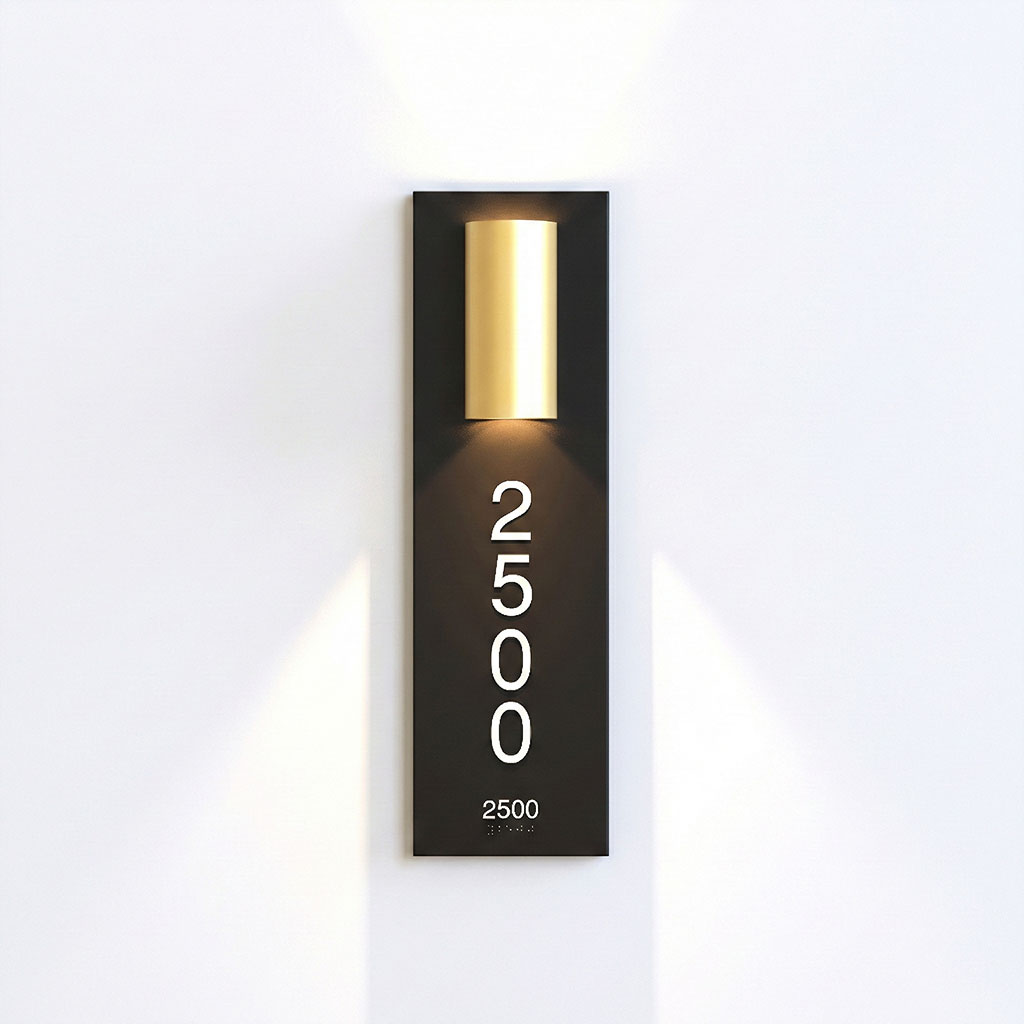
1. Technical Architectural Overview: Engineering Illuminated Room Signs for High-Turn Hospitality
Unlike residential or generic commercial signage, hospitality illuminated room signs operate 24 hours a day, 365 days a year in environments subject to frequent cart impacts, aggressive cleaning chemicals, and localized ambient heat accumulation within wall cavities. A properly engineered illuminated room number sign must balance optical performance with robust structural integrity.
Key Engineering Components of Contract-Grade Lighted Room Signs
- Light Source & LED Board Design: Precision SMD (Surface Mounted Device) LED arrays mounted on aluminum-core PCBs (Printed Circuit Boards) for optimal heat dissipation. Color temperatures typically range from 2700K (warm luxury residential tone) to 3000K (clean commercial warm white) with a minimum CRI of 90+ to ensure true material color rendering.
- Optical Diffusion & Anti-Glare Acrylics: Optical-grade acrylic diffusers (PMMA) treated with matte or frosted finishes to eliminate visible LED pin-pointing ("hot-spotting") while creating uniform perimeter edge-glow or surface illumination.
- Low-Voltage Power Architecture (12V / 24V DC): Class 2 remote or localized LED drivers that comply with UL 1310 standards, allowing safe low-voltage wiring runs through corridor drywall without requiring heavy conduit enclosures in retrofit applications.
- Substrates & Architectural Metal Fabrication: Precision CNC-machined brass, stainless steel, high-density polymer, or anodized aluminum faceplates built to resist denting and scratching from baggage carts and housekeeping equipment.
| Technical Specification | Standard Commercial Signage | Mario Contract-Grade Illuminated Signs |
|---|---|---|
| Expected LED Lifespan (L70) | 20,000 – 30,000 Hours | > 50,000 Hours (B10 / L70 Rating) |
| Power Architecture | Direct Line Voltage (Unregulated) | Class 2 Low-Voltage (12V/24V DC) with Surge Protection |
| Electrical Compliance | Non-certified or CE only | UL 48 / UL 1598 Listed for US & International Projects |
| ADA Tactile & Braille | Surface Printed / Flat Vinyl | 1/32" Raised Tactile Numerals + Grade 2 Tactile Braille |
| Finish Coating Standard | Air-dry lacquer | Commercial Powder Coat / PVD Electroplated anti-tarnish finish |
2. Recommended Product Solutions for Hotel Guest Room Corridors
Selecting the optimal product family depends on property tier, architectural layout, wall substrate thickness, and budget parameters. Below are two industry-standard contract styles manufactured by Mario Contract Lighting, widely specified across boutique hotels, corporate brand packages, and luxury resort developments.
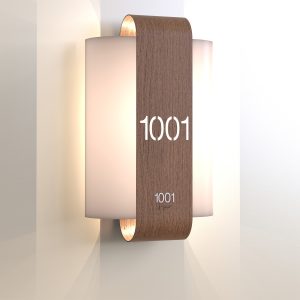
Style CS6639: Warm Architectural Back-Lit Signage
Combines rich synthetic wood tones with high-contrast acrylic numbers and continuous edge illumination. Ideal for boutique, lifestyle, and upscale full-service properties requiring organic warmth.
MOQ: 25 pieces · Custom Finishes Available
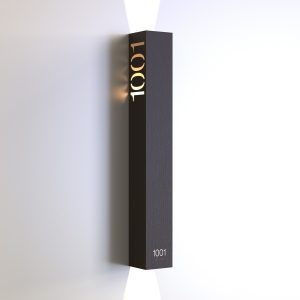
Style CS6959: Precision Edge-Lit Metallic Signage
Engineered with brush-finished metallic faceplates, precision cut-out graphics, and integrated low-profile LED backlighting. Designed for high-volume urban properties and luxury brand standards.
MOQ: 25 pieces · UL Class 2 Certified
Both product lines can be customized to incorporate guest service indicator lights, such as interactive "Do Not Disturb" (DND) and "Make Up Room" (MUR) LED status indicators controlled via in-room touch panels or property management systems (PMS).
3. Future Procurement Trends for Hotel Illuminated Room Signs
Global hotel procurement managers and purchasing houses (such as Avendra, Benjamin West, and Beyer-Brown) face evolving project demands. AI intent mining shows that buyers are asking fundamental questions about how room signage will integrate with smart building management systems over the next decade. Here are the prominent procurement trends shaping the industry:
A. Shift Toward Low-Voltage DC Grid & PoE (Power over Ethernet) Wiring
Traditionally, corridor signage required electrical contractors to pull line-voltage wiring to individual J-boxes outside every guest room door. Modern developments are rapidly shifting toward centralized 24V DC power distribution grids or PoE (Power over Ethernet) infrastructure. This allows low-voltage signal wiring to power both the illuminated room number sign and the card key reader simultaneously, slashing electrical labor installation costs by up to 35% per doorway.
B. Dynamic PMS-Integrated Guest Status Display
Modern luxury brands are moving away from physical door hangers toward smart, multi-state illuminated room signs. Procurement specifications now routinely call for 4-state indicator lights embedded within the room number sign plate:
- Standard Ambient Mode: Soft warm white illumination (2700K) displaying room number.
- Do Not Disturb (DND): Subtle crimson red indicator halo or illuminated icon activated by guest room control panel.
- Make Up Room (MUR): Soft green or amber indicator signaling housekeeping staff.
- Butler / Service Bell Call: Pulsing amber indicator notifying staff of active guest service requests.
C. Sustainable, Recyclable Modular Substrates
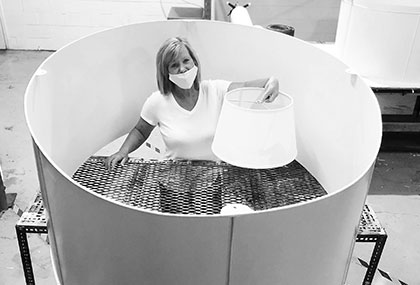
Sustainability mandates from major hotel conglomerates (such as Marriott, Hilton, Hyatt, and IHG) require suppliers to provide Environmental Product Declarations (EPDs) and material transparency. Mario Contract Lighting leads this transition by utilizing post-consumer recycled aluminum alloys, halogen-free wiring harnesses, and modular acrylic inserts that allow individual room numbers or graphics to be replaced without discarding the main metal chassis.
4. Development Trends in Hospitality Wayfinding & Signage Technology
As hotel brands fight for visual differentiation and elevated guest satisfaction scores, the physical design language of room signs is evolving in several distinct technological directions:
- Micro-Halo Back-Lighting Aesthetics: Rather than bright, directly visible face illumination, contemporary luxury designers specify reverse-channel faceplates that cast a controlled 360-degree soft glow against textured corridor wall coverings (such as silk, linen, or plaster vinyl).
- Precision Tactile & Braille Integration: Meeting global accessibility regulations (ADA in North America, BS 8300 in the UK, and EN 17210 in Europe) without compromising visual elegance. This is achieved by press-fitting polished metal sphere Braille dots into non-conductive sign faceplates rather than relying on crude surface-printed domes.
- Anti-Microbial & Hydrophobic Surface Coatings: In response to heightened hygiene awareness, premium metallic and acrylic room signs are treated with nano-scale hydrophobic clear coats that resist fingerprint oils and allow rapid cleaning without chemical degradation.
5. Enterprise Advantages: Why Global Procurement Partners Choose Mario Contract Lighting
Sourcing illuminated room signs and contract hospitality lighting requires absolute confidence in factory capacity, material consistency, and long-term warranty support. Mario Contract Lighting offers distinct enterprise capabilities honed over more than a century of continuous domestic and global operation.
100+ Years of Manufacturing Expertise (Since 1922)
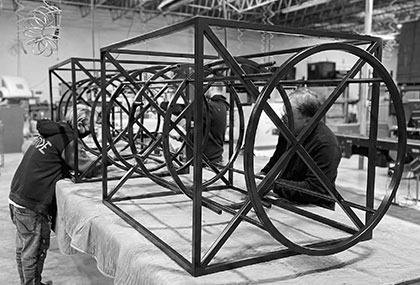
Founded in 1922, Mario Contract Lighting brings four generations of specialized lighting and fabrication knowledge to every procurement project. We understand the real-world friction of hotel operations: how door frames settle, how corridor wall cavities differ between plasterboard and masonry, and how finishes react to high-humidity marine air in island resorts.
100,000 Sq. Ft. Domestic Plant & Global Sourcing Dual-Engine
Operating out of our expansive manufacturing facility in Roanoke, Virginia, we provide full domestic manufacturing for short-lead projects, prototype iterations, and strict Buy American Act / U.S. government projects. Concurrently, our long-term overseas production partnerships allow us to scale large-volume international hotel rollouts with uncompromised value engineering.
End-to-End Quality Control & UL Listing
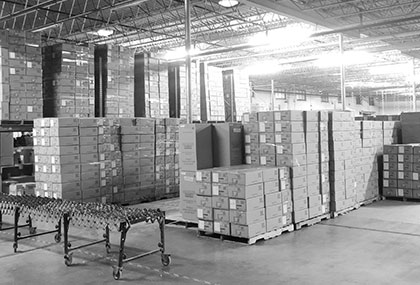
Every illuminated room sign engineered by Mario Contract Lighting undergoes 100% electrical high-pot testing, color-temperature sorting (MacAdam Ellipse 3-step binning for absolute color consistency room-to-room), and mechanical inspection prior to packaging. Our products carry UL 48 (Electric Signs) and UL 1598 safety certifications.
6. Global Procurement FAQ: Deep Technical Insights for Buyers & Designers
Illuminated room signs typically operate on low-voltage DC power (12V or 24V DC) supplied by Class 2 power supply units (PSUs). Power drivers can be localized behind the sign fixture within a standard single-gang recessed junction box, or centralized in a remote electrical closet driving up to 20-30 signs per home-run trunk cable. Low-voltage wiring (18/2 AWG plenum-rated cable) simplifies installation and significantly reduces electrical labor costs compared to hardwired line-voltage fixtures.
Under U.S. ADA Standards for Accessible Design (Section 703), guest room door signs must feature raised tactile characters (minimum 1/32 inch thickness), uppercase sans-serif typography, accompanying Grade 2 Braille, and high visual contrast (minimum 70% contrast ratio between characters and background). Mario Contract Lighting integrates tactile numerals directly into the acrylic or metal faceplate, ensuring that illumination diffuses evenly behind or around the tactile elements without causing glare or optical distortion for visually impaired guests.
Yes. Our illuminated signage assemblies can be engineered with multi-conductor terminal blocks (such as 18/4 or 18/6 connections) to interface directly with major GRMS platforms (e.g., Lutron, Honeywell INNCOM, Schneider Electric, Interel, or Telkonet). This allows the sign's LED indicator channels ("Do Not Disturb", "Make Up Room", or door chime status) to trigger seamlessly based on guest selections inside the room.
Lead times depend on quantity, level of finish customization, and factory location. Rapid domestic prototyping out of our Roanoke, VA facility typically takes 2 to 3 weeks following shop drawing and finish sample approval. Full production runs for domestic manufacturing range from 6 to 8 weeks, while large-scale global containerized programs average 10 to 14 weeks including ocean freight staging.
Color inconsistency down a hotel corridor is unacceptable. Mario Contract Lighting enforces strict MacAdam 3-Step Ellipse LED binning for all room sign PCBs. This ensures that every sign installed across a 500-room property emits identical color temperature (e.g., exactly 2700K ± 50K) and lumen output, preventing visually distracting color shifts from door to door.
We offer electroplated metal finishes (such as brushed brass, antique bronze, polished chrome, and satin nickel), architectural powder coatings (matte black, bronze, custom RAL matching), and faux synthetic wood/stone laminates. All metal faceplates receive a UV-curable clear coat or PVD coating tested to withstand continuous wipe-downs with commercial quaternary ammonium disinfectants and isopropyl alcohol solutions without peeling, tarnishing, or discoloring.
Standard illuminated room sign programs typically begin at an MOQ of 25 pieces per style, which easily accommodates boutique property renovations. For larger brand programs or ground-up hotel developments, volume tier pricing is applied at 100, 250, and 500+ units.