
Choosing a supplier for commercial flush mount lighting is not just a price comparison. A fixture must suit the ceiling, room size, operating hours, and maintenance plan. In a hotel corridor, for example, glare and uneven light can be noticed every evening. In a warehouse office, easy replacement may matter more than decorative detail.
Lighting designer Richard Kelly wrote, “Light is not so much something that reveals, as it is itself the revelation.” His idea is a useful reminder: a compact fixture still shapes how a space feels and functions. This guide to China’s top 10 commercial flush mount lighting suppliers looks beyond product photos. It considers fixture range, material and finish options, technical documentation, customization, communication, and support for project orders. Details matter.
A supplier’s product page can look convincing. It may not answer questions about driver quality, dimming compatibility, or replacement parts. Buyers should request clear specifications and sample testing where practical. No supplier is best for every project, and a ranking cannot replace due diligence. That is worth remembering. The comparison ahead is intended to help contractors, distributors, and facility teams build a shortlist, then verify each candidate against their actual installation needs.
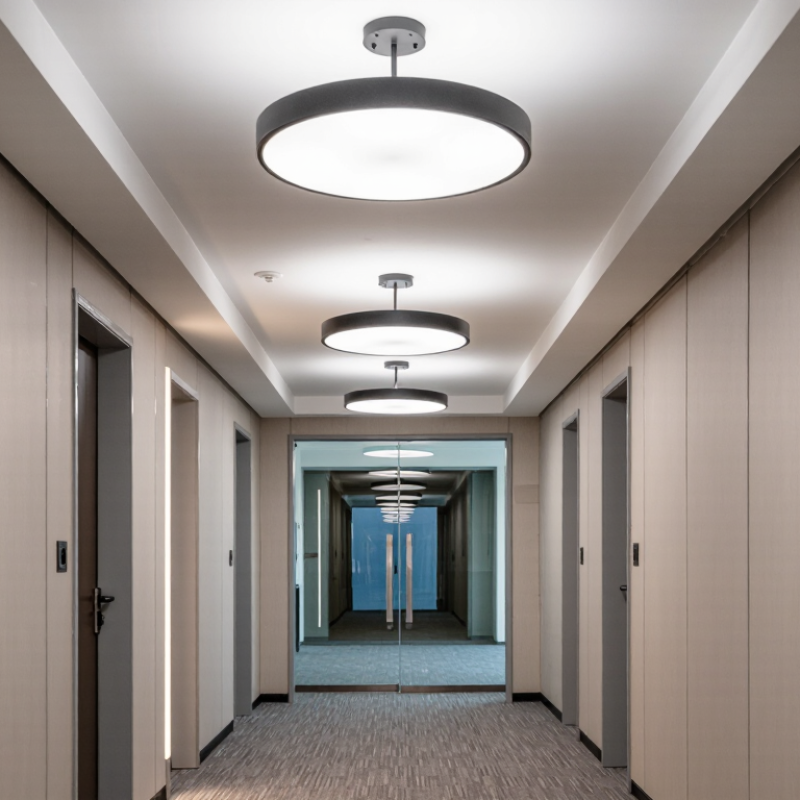
Commercial flush mount fixtures sit close to the ceiling, making them useful where headroom is limited. Common types include shallow LED panels, enclosed drum fixtures, and sealed units for damp or dusty spaces. They appear in offices, corridors, classrooms, retail areas, and service rooms. The U.S. Department of Energy’s 2020 U.S. Lighting Market Characterization reports that LEDs represented 48% of installed U.S. lighting stock. That shift makes driver quality, heat management, and replaceability practical purchasing concerns—not just specification details.
A typical fixture includes a housing, mounting plate, LED board, driver, and diffuser. The housing supports the assembly, while the diffuser softens glare and spreads light across desks or walkways. In humid areas, gaskets and sealed connections help protect internal components. Check the driver’s compatibility with dimming controls, and compare color temperature and color rendering for the task. A bright fixture can still feel harsh. This is easy to overlook on a product sheet.
China Top 10 Commercial Flush Mount Lighting Suppliers?
For commercial flush mounts, compare documented performance—not just catalog claims. Specify CRI ≥80, then request the test method and product-level report. ENERGY STAR’s luminaire specification uses CRI 80 as a baseline, while color-sensitive spaces may need stricter review. Numbers need context. Ask for LM-80 test data and a TM-21 projection supporting L70 ≥50,000 hours; L70 is a lumen-maintenance estimate, not a promise that every fixture will operate for that duration. Check the projected temperature and drive current against the intended ceiling conditions.
Efficacy should be stated in lumens per watt for the complete luminaire, not the LED package alone. The U.S. Department of Energy’s 2022 Solid-State Lighting R&D Opportunities report discusses leading white-LED package efficacy above 200 lm/W; optics, drivers, and heat reduce finished-fixture output. A practical bid screen is at least 100 lm/W, with higher targets where glare and uniformity remain acceptable. Compare measured input watts and delivered lumens from test reports. I still find this easy to miss: a high efficacy figure can hide harsh brightness or weak color consistency. Check sample fixtures in the actual ceiling grid before final approval.
How to Assess China’s Top 10 Commercial Flush Mount Lighting Suppliers
A polished catalog proves little about a supplier’s production discipline. Ask for dated photometric reports, product drawings, and a sample built to your actual ceiling height and voltage. The U.S. Department of Energy reports that LED lighting uses at least 75% less energy than incandescent lighting. That benchmark helps frame efficiency claims, but it does not verify any individual fixture. Request test data for the exact model, including light output, power consumption, color temperature, and beam distribution. Check that the report comes from a qualified laboratory.
Look closely at construction. Inspect the diffuser for uneven brightness, the metal housing for sharp edges, and the driver compartment for adequate heat management. Ask how the supplier controls component substitutions and checks each production batch. A supplier’s willingness to share inspection records can be more useful than a long product list. For glare and visual comfort, compare measured photometric data with the project’s lighting plan; a bright sample alone can mislead.
Then test the relationship. Send the same inquiry to each shortlisted supplier and compare response times, technical detail, sample lead times, and warranty terms. Ask for references from projects with similar operating hours and mounting conditions. Small differences matter. A factory audit may reveal gaps, yet it cannot predict every production issue. Keep that uncertainty in the evaluation, and verify critical claims through independent testing before placing a large order.
Use this proposed scorecard to compare suppliers consistently. The weightings are evaluation recommendations, not verified rankings or company-specific performance data. Confirm product claims and certifications against current documents and independent test reports.
| Assessment dimension | Suggested weight | Evidence to request | What to assess |
|---|---|---|---|
| Safety and regulatory documentation | 18% | Current certificates, test reports, product labels, and applicable-market declarations | Check that documents apply to the exact model, configuration, and destination market; verify validity with the issuing body where possible. |
| Photometric performance | 15% | IES or LDT files and an accredited laboratory photometric report | Compare measured light output, distribution, efficacy, and glare-related data with the project specification. |
| Electrical and LED specifications | 12% | Datasheets for the fixture, LED module, and driver; declared input and dimming details | Check that voltage, frequency, power, power factor, dimming method, and component details match the intended application. |
| Thermal management and rated life | 10% | Thermal test information, declared ambient-temperature limits, and documented lifetime basis | Review the test conditions and the basis for lifetime claims; distinguish measured data from estimates. |
| Materials and construction | 9% | Bill of materials, finish specifications, drawings, and sample inspection | Assess housing, diffuser, fastening, finish consistency, and suitability for the installation environment. |
| Quality management and inspection | 9% | Quality-system certificates, inspection procedures, and sample production records | Check certificate scope and expiry, documented incoming and final checks, and the process for handling defects. |
| Customization and engineering support | 8% | Available configurations, technical drawings, sample-change records, and response process | Evaluate the supplier’s ability to document and control requested changes to dimensions, finish, optics, or controls. |
| Warranty and after-sales support | 7% | Written warranty terms, exclusions, claim procedure, and spare-parts policy | Compare coverage, remedy, claim requirements, and the availability of replacement components. |
| Production and delivery capability | 7% | Documented production schedule, capacity statement, packaging details, and shipment records | Validate lead-time assumptions, order capacity, packaging suitability, and the supplier’s process for schedule changes. |
| Commercial terms and total cost | 5% | Itemized quotation, payment terms, minimum order quantity, and shipping assumptions | Compare like-for-like specifications and account for tooling, samples, packaging, freight, and other stated costs. |
| Total suggested weighting | 100% | Score each dimension using the same scale, retain supporting evidence, and avoid treating unverified claims as confirmed results. | |
Suggested scoring scale: 1 = insufficient evidence or major gaps; 2 = below requirements; 3 = meets documented requirements; 4 = strong evidence and performance; 5 = independently verified, strong performance. Weighted score = dimension score ÷ 5 × suggested weight.
A useful comparison of China’s commercial flush-mount lighting suppliers should look beyond catalog photos. Product ranges may include slim LED panels, sealed ceiling fixtures, corridor lights, and higher-output models for offices or hotels. Check dimensions, lumen output, color temperature, glare control, and driver options. Small details matter. A fixture that looks suitable online may sit too low beneath a ceiling beam.
Customization can cover housing colors, trim, wattage, sensor options, packaging, and compatible dimming systems. Ask which changes are standard and which require new tooling. Request a sample with the proposed driver and finish. Test it in the intended space, not just on a workbench. One weak point: sample performance may not represent every production batch, so confirm inspection procedures in writing.
Capacity claims need specifics. Ask about monthly output for the exact fixture type, current lead times, and how orders are checked before shipment. Certifications should match the product model and destination market; review current documents and their scope rather than relying on a factory’s general claim. Request test reports, warranty terms, and spare-part availability. Numbers alone are not enough. A supplier profile is more useful when it explains its limits, too.
A supplier-by-supplier comparison of product ranges, customization, certifications, and production capacity requires verified supplier data. Since no source profiles were provided, this chart instead shows commonly used nominal LED color-temperature options; it is not a ranking or a survey of Chinese suppliers.
How to read: The bars show nominal color-temperature values in kelvin (K). Actual options vary by product and supplier; verify specifications, certifications, customization capability, and production capacity directly with each manufacturer.
Sourcing Checklist: Compliance, Quality Testing, Lead Times, and Warranty
When comparing commercial flush mount lighting suppliers in China, request documents for the exact model and destination market. Check applicable safety and electromagnetic compatibility requirements, plus material declarations where relevant. Confirm that model numbers match across reports, labels, and quotations. Paperwork can look tidy. That is not proof.
Ask how production units are tested, not just how a sample was checked. A useful quality plan may include inspections of wiring, grounding, finish, diffuser fit, and light output. Request test criteria, inspection records, and traceability for components. Approve a pre-production sample, then agree how changes will be handled. A beautiful sample can still hide a weak process.
Get lead times in writing, with separate dates for sample approval, production, inspection, and shipment. Clarify what starts the production clock; drawings or payment may be prerequisites. For the warranty, define duration, covered failures, replacement parts, labor, and response times. Ask who pays freight for confirmed defects. I would still allow schedule buffer: factory estimates can miss real-world delays.
Use CRI 80 as a baseline, then request the exact model’s test method and report. Color-sensitive rooms may need stricter review. Check a sample under the room’s actual lighting conditions.
It estimates when light output may reach 70% of its initial level. It does not guarantee every fixture will operate for 50,000 hours. Request LM-80 data and a TM-21 projection, including tested temperature and drive current. Small print matters.
Compare complete-fixture lumens per watt, not LED-package figures. A practical screening target is 100 lm/W or higher. Review measured input watts and delivered lumens, then check glare and color consistency. I still find this easy to miss: high efficacy can hide harsh brightness.
Review dimensions, light output, color temperature, glare control, and driver options for each model. Check how far the fixture sits below beams or ceilings. Catalog photos can hide that detail.
Ask whether housing color, trim, wattage, sensors, packaging, and dimming are standard or require new tooling. Request a sample with the proposed driver and finish. Test it in the intended ceiling grid; workbench results may differ.
Request current documents for the exact model and destination market. Match model numbers across reports, labels, and quotations. Review applicable safety, electromagnetic compatibility, and material declarations. Paperwork is not proof.
Ask for criteria and records covering wiring, grounding, finish, diffuser fit, and light output. Confirm component traceability and how production changes are controlled. A strong sample alone proves little.
Put sample approval, production, inspection, and shipment dates in writing. Clarify whether drawings or payment start the production clock. Define warranty duration, covered failures, spare parts, labor, response times, and freight for confirmed defects. Allow some buffer.
Commercial flush mount lighting offers a practical solution for offices, retail spaces, schools, healthcare facilities, and other commercial interiors where a low-profile fixture is preferred. Common options include LED panels, surface-mounted downlights, and enclosed ceiling fixtures, built from components such as the light source, driver, housing, diffuser, and mounting hardware. When comparing products, buyers can use key benchmarks such as a color rendering index of at least 80, an L70 rated life of 50,000 hours or more, and suitable luminous efficacy for the intended application.
Assessing suppliers involves more than comparing prices. Review their product range, customization capabilities, production capacity, quality controls, and relevant certifications, while confirming that specifications are clearly documented. Before placing an order, check compliance requirements for the destination market, request test records or samples, verify lead times and packaging details, and clarify warranty coverage and after-sales support. A structured sourcing process helps buyers select dependable products that meet project needs and support consistent performance over time.