
Commercial track lighting fixtures are a practical choice for shops, galleries, and showrooms where displays change often. A track can turn a narrow beam onto a product shelf, then redirect it toward a new arrangement without rewiring the ceiling. That flexibility is useful, but it does not guarantee comfortable light or good color.
The U.S. Energy Information Administration’s 2018 Commercial Buildings Energy Consumption Survey reports that lighting accounted for about 17% of commercial-building electricity use. The U.S. Department of Energy notes that LED lamps use at least 75% less energy than incandescent lamps. These figures make efficiency worth checking, not assuming. Ingo Maurer, the influential lighting designer, expressed a related design idea: “I do not work with light, I work with shadows.” His words suit track lighting, where beam direction and contrast shape what customers notice.
This guide examines ten Chinese suppliers of commercial track lighting fixtures, with attention to product range, technical documentation, and practical buying considerations. Compare beam angles, color rendering, dimming compatibility, driver quality, and warranty terms. Ask for photometric files and test samples when possible; a polished catalog cannot show every detail. No specification sheet tells the whole story. Installation conditions and actual merchandise can change the result. Use the list as a starting point, then verify claims directly with each supplier.
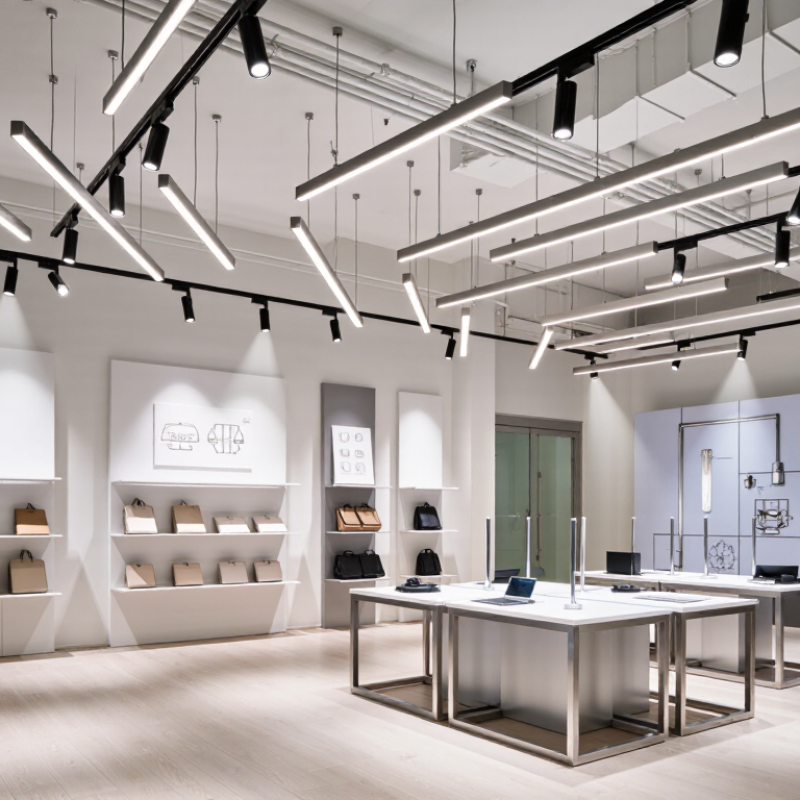
China Top 10 Commercial Track Lighting Fixture Suppliers
Commercial Track Lighting Fundamentals: 1-, 2-, and 3-Circuit Track Systems
A one-circuit track supplies power through a single electrical channel. Every compatible fixture on that track usually switches together. Simple to plan. Less flexible later. In a small shop, that may be enough for a row of display shelves.
Two-circuit track provides two independently controlled groups, when paired with compatible fixtures and controls. For example, a café can keep the counter lights on while dimming the seating area. Three-circuit systems add a third group, useful in galleries or large retail floors with changing display zones. More circuits do not automatically mean better lighting; check adapter compatibility, load limits, and control requirements before specifying equipment.
The UNEP and GlobalABC 2023 Global Status Report for Buildings and Construction estimates that buildings and construction represented 34% of global energy demand in 2022. It also attributes 37% of energy- and process-related CO₂ emissions to the sector. These figures are not specific to track lighting, but they underline why zoning matters. Switching off an unused display group can reduce unnecessary operating hours. A detail teams sometimes miss: circuit labels should match the actual control plan. They do not always. Verify the wiring diagram on site.
When comparing commercial track lighting fixture suppliers, treat performance figures as starting points, not guarantees. A stated efficacy of 100–150 lm/W can support lower energy use, but confirm it applies to the complete fixture. Request test data showing input wattage and delivered lumens at the intended operating temperature. Optics and driver losses can change the result. Paper ratings are not the whole story.
For retail shelves, galleries, and showrooms, CRI ≥90 helps reveal fabric, paint, and food colors more faithfully. Check R9 values when saturated reds matter. Beam angles from 15° to 60° cover focused accents and broader wall washes. Match the optic to ceiling height and target width; a 24° beam can create a hotspot on a low ceiling. Test a sample in the actual space. Rooms can surprise you.
Tips: Compare photometric files, glare control, flicker data, warranty terms, and replaceable components. Check whether the supplier reports efficacy consistently. I would not choose a fixture on lumens alone; color quality and beam control may matter more for the task. One trade-off is unavoidable.
China’s leading commercial track-lighting suppliers should be compared by usable range, not catalogue size. Look for adjustable heads, narrow and wide beam options, dimming compatibility, glare control, and replaceable drivers. Ask whether published photometric files match samples; a 24-degree beam can feel harsh on glossy displays. Details matter.
Factory capacity means more than monthly output claims; check line count, aging racks, inspection steps, and lead-time records. A credible top-ten comparison should separate in-house machining and assembly from outsourced components. Export readiness also depends on carton protection, spare parts, multilingual manuals, and consistent electrical documentation. Compare actual destination markets and repeat shipment history, rather than accepting a broad “worldwide” claim. The IEA’s Energy Efficiency 2023 report estimates lighting uses about 4% of global electricity, underscoring why efficacy and controls deserve scrutiny. That estimate is not a fixture-level rating; buyers should verify delivered lumens, wattage, thermal stability, and warranty terms.
Product Portfolios, Factory Capacity, and Export Markets
No source article or dataset was provided, so no supplier figures can be verified. The chart records the number of source-backed metrics available in the supplied material for each comparison area; zero indicates that none were provided.
Commercial track fixtures rated from 10 to 40 W suit different tasks, but wattage alone does not predict useful brightness. Compare delivered lumens, beam angle, and color rendering data. A narrow beam can highlight a shelf, while a wider beam spreads light across a counter. Small detail. For a practical comparison, request the same measurements at each wattage and check whether the values describe the complete fixture.
Color temperature from 2700 K to 5000 K changes how merchandise and surfaces appear. Warm 2700 K light can feel comfortable in hospitality spaces; cooler settings may suit crisp product displays. The best choice depends on the materials and surrounding light. Dimming options also matter. Phase-cut drivers may work with familiar wall controls, while 0–10 V or digital systems can offer more predictable control when properly matched. Ask suppliers for driver compatibility, minimum dimming level, and flicker test information. Still, this comparison is imperfect: low-level performance can vary by driver, control, and installation, even when headline specifications look similar. I would verify a sample before specifying a large quantity.
| Reference Profile | Rated Power | Typical Light Output* | CCT Range | Typical CRI | Common Beam Angles | Dimming Options** | Common Applications |
|---|---|---|---|---|---|---|---|
| 01 · Compact accent | 10 W | 900–1,200 lm | 2700–3000 K | ≥80; ≥90 options | 15° / 24° / 36° | Phase-cut or non-dimmable versions | Small displays, shelving, and focused accent lighting |
| 02 · Warm retail spot | 12 W | 1,080–1,440 lm | 2700–3500 K | ≥80; ≥90 options | 15° / 24° / 36° | Phase-cut; 0–10 V versions may be available | Apparel displays, hospitality, and warm-toned merchandise |
| 03 · General-purpose spot | 15 W | 1,350–1,800 lm | 3000–4000 K | ≥80; ≥90 options | 24° / 36° / 60° | Phase-cut or 0–10 V, depending on driver | Retail displays and small commercial interiors |
| 04 · Adjustable white option | 18 W | 1,620–2,160 lm | 2700–5000 K selectable option | ≥80; ≥90 options | 24° / 36° / 60° | 0–10 V or DALI versions; control compatibility required | Showrooms and spaces requiring adjustable color temperature |
| 05 · Mid-power accent | 20 W | 1,800–2,400 lm | 3000–4000 K | ≥80; ≥90 options | 15° / 24° / 36° / 60° | Phase-cut, 0–10 V, or DALI versions | Feature walls, product displays, and medium-height ceilings |
| 06 · High-output retail spot | 24 W | 2,160–2,880 lm | 3000–5000 K | ≥80; ≥90 options | 24° / 36° / 60° | 0–10 V or DALI versions commonly specified | Department stores and brighter retail environments |
| 07 · Broad-beam commercial | 28 W | 2,520–3,360 lm | 3000–4000 K | ≥80; ≥90 options | 36° / 60° | 0–10 V; DALI option may be available | General merchandise areas and wider display zones |
| 08 · High-ceiling accent | 30 W | 2,700–3,600 lm | 3000–5000 K | ≥80; ≥90 options | 15° / 24° / 36° | 0–10 V or DALI versions; check track and driver pairing | High-ceiling retail, galleries, and larger feature displays |
| 09 · High-output adjustable option | 35 W | 3,150–4,200 lm | 2700–5000 K selectable option | ≥80; ≥90 options | 24° / 36° / 60° | 0–10 V or DALI versions; verify control-system requirements | Large showrooms and flexible commercial display lighting |
| 10 · Maximum-output profile | 40 W | 3,600–4,800 lm | 3000–5000 K | ≥80; ≥90 options | 24° / 36° / 60° | 0–10 V or DALI versions commonly specified | Large retail spaces, high ceilings, and broad accent coverage |
| * Light-output figures are indicative estimates based on a broad 90–120 lm/W range; actual output varies with LED, optics, driver, and configuration. CCT ranges, CRI, beam angles, and dimming protocols are representative options, not supplier-specific verified specifications. Confirm the exact fixture, track system, driver, controls, and applicable electrical certifications before purchase. | |||||||
When comparing commercial track lighting suppliers in China, ask for compliance documents tied to the exact fixture model. IEC or GB references alone are not proof of conformity. Check the standard number, product scope, report date, and testing laboratory. Confirm that the tested driver, track adapter, and LED configuration match your quotation. A polished certificate folder can still leave gaps.
Review LM-80 data for the LED package or module, including test conditions and operating hours. LM-80 does not certify the complete fixture. Ask how the supplier uses the data for lifetime projections, and whether the assumptions fit your operating temperature. This detail is easy to rush. It should not be. Get warranty terms in writing, covering duration, driver failures, replacement process, and exclusions. A long warranty means little if response times are unclear.
Test physical samples before placing a large order. Mount them on the intended track, then check adapter fit, aiming movement, dimming behavior, and visible flicker. Measure light output and inspect beam edges on a real work surface, not only in a catalog image. Run the sample for several hours and note housing temperature. Keep one approved unit as a reference. Supplier samples may be hand-finished, so ask whether production units will use the same components and assembly checks.
One-circuit tracks usually switch all compatible fixtures together. Two-circuit tracks allow two groups to operate independently. Three-circuit systems add a third group. More circuits are not always better.
It can suit a small shop with one row of display shelves. All fixtures switch together, so planning stays simple. That simplicity may feel limiting later.
A café can keep counter lights on while dimming its seating area. A gallery can control separate display zones. Check that fixtures and controls support the chosen circuits.
Compare adjustable heads, beam options, dimming support, glare control, and replaceable drivers. Ask whether photometric files match physical samples. A 24-degree beam may look harsh on glossy shelves.
Review production lines, aging racks, inspection steps, and lead-time records. Ask which parts are made in-house and which are outsourced. Output claims alone tell little.
Compare delivered lumens, beam angle, and color-rendering data. A narrow beam can highlight one shelf; a wider beam covers a counter. Small detail.
Warm 2700 K light may suit a hospitality space. Cooler light can make product displays look crisp. Test it against the actual merchandise and nearby lighting.
Confirm driver compatibility, minimum dimming level, and flicker test information. Phase-cut controls may suit familiar wall switches; 0–10 V or digital controls need proper matching. Test a sample first.
This guide explains the fundamentals of commercial track lighting fixtures, including how 1-, 2-, and 3-circuit track systems differ and how to match them with project needs. It outlines practical selection benchmarks, such as efficacy of 100–150 lm/W, CRI of at least 90, and beam angles from 15° to 60°. It also compares common fixture specifications, covering 10–40 W power ranges, 2700–5000 K color temperatures, and available dimming options.
The guide surveys ten Chinese suppliers by considering their product ranges, manufacturing capacity, and export experience, without relying on brand claims alone. It also provides a due-diligence framework for buyers: verify relevant IEC or GB compliance documentation, review LM-80 data where applicable, clarify warranty terms, and evaluate samples before placing an order. These steps help businesses compare suppliers and select lighting solutions suited to their installation, performance, and procurement requirements.