
We Customize Everything— Proudly Since 1922
800-458-1244 [email protected]
Custom Request We Customize Everything— Proudly Since 1922
A contract-grade desk lamp is more than a polished object beside a keyboard. It must deliver dependable task lighting across offices, hotels, libraries, and other shared spaces. Architect Louis Kahn observed, “A room is not a room without natural light.” His words remind specifiers that electric light shapes how people experience a space, too. The right desk lamp should support focused work without harsh glare or distracting reflections.
This guide introduces China’s top 10 contract grade desk lamp suppliers and the practical questions buyers should ask. Look beyond a product photo. Check published light output, color rendering, dimming options, flicker performance, material quality, warranty terms, and replacement-part availability. Ask whether samples can be tested at an actual desk, under the same screens and finishes used in the project. Small details matter. A heavy base may feel reassuring, yet take up valuable workspace. A sleek arm may look ideal, but drift after repeated adjustment.
Supplier quality can be harder to judge than product design. That deserves a closer look. Compare documented specifications, production experience, quality-control processes, customization capacity, lead times, and after-sales support. Request clear answers, not just attractive catalogs. This overview is a starting point, not a substitute for product testing or project-specific review. Some supplier information may change, and a promising specification can still fall short in daily use. Test before committing.
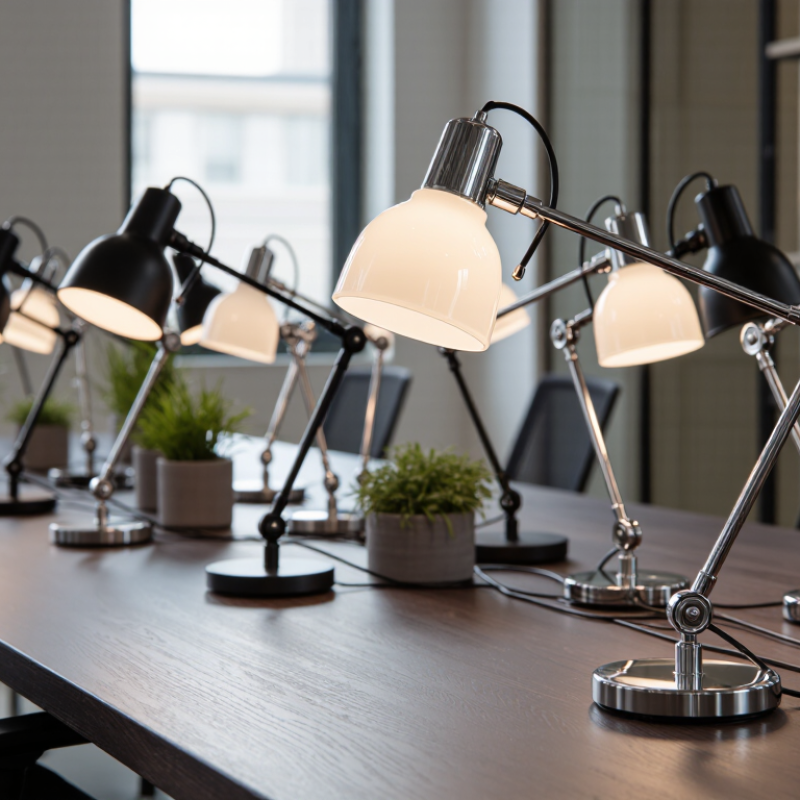
“Contract-grade” is not a universal rating. It should describe a desk lamp supported by verifiable safety, performance, and durability evidence. Ask for electrical safety documentation, photometric test results, and clear warranty terms. IEC 60598-1 sets general safety requirements for luminaires; IES LM-79 provides methods for measuring solid-state lighting performance. These references help buyers compare measured results, not just catalog claims. Details matter. Check the lamp at the work surface, where glare, uneven light, and flicker can affect daily use.
For office writing, EN 12464-1 uses 500 lux as a typical maintained illuminance level for the task area. Treat this as a useful reference, not a universal desk-lamp pass mark; room lighting and screen use change the result. The U.S. Department of Energy reports that LEDs use at least 75% less energy and can last up to 25 times longer than incandescent lighting. Those figures describe LED lighting broadly, not every finished lamp. Ask suppliers for test conditions and measured product data. Inspect the hinge, switch, and cable strain relief, too. These small parts often reveal build quality. One gap remains: “contract-grade” can still be vague when buyers do not specify testing and service expectations.
“Contract-grade” is a procurement description, not a single universal certification. The table below compares ten supplier evaluation areas and verification points; it does not rank or identify individual companies.
| No. | Supplier Evaluation Area | What to Verify | Evidence or Procurement Benchmark |
|---|---|---|---|
| 1 | Product safety compliance | Confirm that the complete desk-lamp model has been assessed for applicable electrical and mechanical safety requirements in the destination market. | Request model-specific test reports. IEC 60598-1 covers general luminaire requirements; IEC 60598-2-4 covers portable general-purpose luminaires. |
| 2 | Photobiological safety | Check whether the LED light source and luminaire have been evaluated for photobiological hazards under the relevant test method. | Ask for an applicable IEC 62471 assessment or equivalent market-required documentation for the exact configuration. |
| 3 | LED driver and electrical components | Review the driver specification, electrical ratings, protection features, and component traceability. | Check applicable controlgear documentation, including IEC 61347 requirements where relevant, and confirm that approved components match the shipped product. |
| 4 | Light performance and consistency | Specify measurable requirements for illuminance, color rendering, color temperature, flicker, and unit-to-unit consistency. | Use a written product specification and independent or calibrated test results. Treat targets such as CRI ≥ 90 as buyer requirements, not a universal definition of contract grade. |
| 5 | Mechanical durability | Assess base stability, arm movement, hinge retention, adjustment range, and resistance to wear during repeated use. | Request documented design or test criteria and inspect production-representative samples; set pass/fail limits in the purchase specification. |
| 6 | Materials and finish control | Verify material declarations, finish specifications, color matching, and controls for visible defects or corrosion where applicable. | Approve a reference sample and written material/finish criteria; check incoming inspection records and change-control procedures. |
| 7 | Quality management and production control | Review documented procedures for incoming materials, in-process checks, final inspection, nonconforming products, and corrective actions. | An ISO 9001 certificate, if provided, relates to a quality management system; it is not product certification. Verify its scope, validity, and issuing body. |
| 8 | Customization and change control | Confirm the supplier can document approved options such as finish, cable length, plug type, packaging, or control interface, where offered. | Require approved drawings or specifications, sample sign-off, and written notification and approval for changes to components or manufacturing processes. |
| 9 | Traceability and shipment documentation | Check whether products can be linked to production batches and whether the supplier can provide consistent shipment and compliance records. | Agree on required labels, batch or date codes, packing lists, test documentation, and destination-market declarations before ordering. |
| 10 | Warranty and after-sales process | Review warranty coverage, claim handling, replacement-part availability, response times, and responsibility for shipping or labor costs. | Set the warranty duration and service-level expectations in the contract; these are commercial terms and are not uniform across suppliers. |
Note: Applicable standards and certification requirements depend on product design and destination market. Verify current requirements and certificates for the exact model before purchase.
It is not a universal rating. Look for verifiable safety, light-performance, and durability evidence, plus clear warranty terms.
Ask for electrical safety records, photometric test results, and warranty details. Match report identifiers to the exact lamp model. Check test conditions, too.
Around 500 lux is a useful maintained illuminance reference for the task area. Room lighting and screen use can change the result. It is not a universal pass mark.
Check glare, flicker, color rendering, color temperature, and dimming behavior at the work surface. A CRI value alone is partial.
Test the hinge, switch, cable strain relief, and base stability. These small parts can reveal weak construction. Look for wobble.
A realistic test may reveal heat buildup or dimming problems. It cannot replace formal testing. A polished sample can still mislead.
Later batches may differ from the sample, and paperwork can lag behind component changes. Request repeat-test records and change-control details. Easy to miss.
Supplier networks can provide nearby components and flexible customization. Capabilities vary, though, and desk-lamp export data are difficult to isolate. Verify each supplier’s records.
This article explains what sets contract grade desk lamps apart from ordinary desk lighting, including their suitability for frequent use, consistent illumination, durable construction, and ease of maintenance. It also outlines the performance and compliance considerations buyers should review, such as light quality, electrical safety, energy efficiency, material reliability, and documentation appropriate to the intended market.
Readers will gain an overview of China’s desk lamp manufacturing landscape and a practical framework for evaluating suppliers. Key considerations include production capabilities, quality-control processes, customization options, communication, lead times, and after-sales support. The article then profiles ten Chinese suppliers to help commercial buyers compare their strengths and identify potential partners for sourcing dependable contract grade desk lamps.